


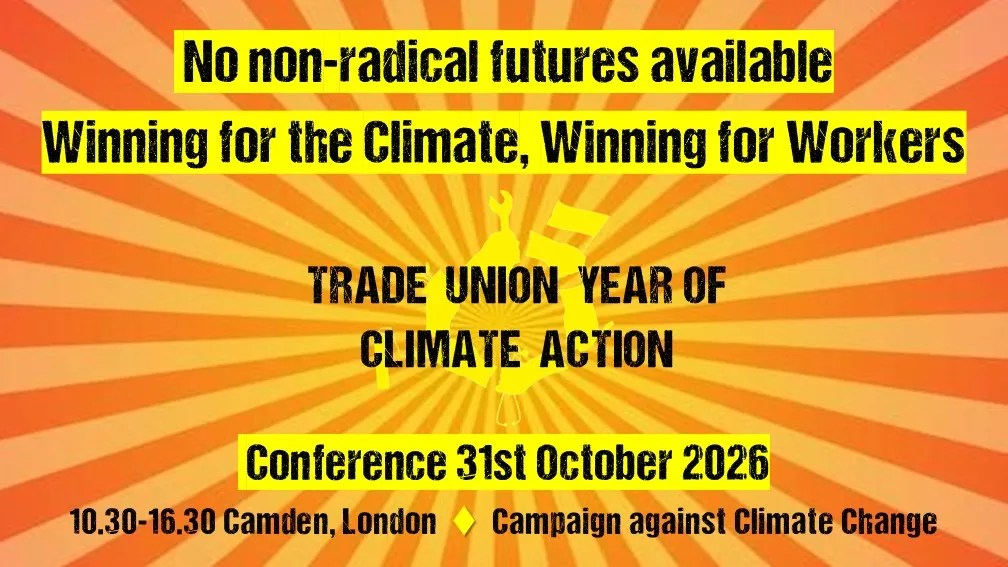
The Trade Union Year of Climate Action has also been a year of frightening heatwaves, wildfires and floods. Without strong action we’ll continue to see these impacts escalating, hitting the poorest hardest, and bringing global tipping points closer. Normalising this as the new reality would be disastrous for working class people globally.
Too many people are struggling to make ends meet, while the richest profit at the expense of people and planet, and the far right grow by exploiting this misery. Dangerous new wars are being waged which destroy lives and deepen these crises. Business as usual is not an option. It’s time for the trade union movement to step up and demand a ‘just transformation’ towards a liveable planet as well as a fairer and more peaceful society in line with the reality of the climate and ecological crises we face.
The UK’s continuing dependence on fossil fuels means energy companies profiteering at our expense. New oil licences in the declining North Sea basin are a climate threat but won’t ensure sustainable jobs. We need a fairer energy system that meets our needs and protects workers.
Speakers: Pete Cannell, ScotE3 (Employment, Energy and Environment); Mike Sarnecki, oil rig caterer, currently Worker Organiser with Platform; Rosemary Harris, North Sea Senior Campaigner at Oil Change International.
Soaring gas prices and badly-insulated homes have left many unable to heat their homes in winter and overheating in summer. We urgently need to cut emissions from our homes, but market-based retrofit schemes have gone disastrously wrong in the past. Decent housing means climate action and climate jobs.
Speakers: Sam Perry, TUC policy lead for home energy and climate, Professor Linda Clarke, expert on labour, training and education within construction and retrofit; Madeleine Pauker, PhD researcher on the political economy of housing and co-author of a recent report on place-based retrofit.
From heatwaves, wildfires and drought, to more intense rainfall and increasing floods, climate breakdown is here now, in our homes, workplaces and communities. In the UK and around the world the worst impacts fall on those who have done least to cause the crisis.
Speakers include: Professor Paul Behrens, expert on food systems, climate and sustainability; Coral Jones, Chair, Doctors in Unite; James Rodgers, firefighter and FBU activist; Graham Petersen, Greener Jobs Alliance and Trade Union Clean Air Network;
The same forces whipping up hate against migrants also promote climate denial and delay, even as the impacts of climate breakdown become ever more obvious. The networks behind the far right and fossil fuel interests are global, and effective resistance needs to be built in local communities.
Speakers include: Denis Fernando, Stand Up To Racism; Sam Bright, Deputy Editor, DeSmog, a leading platform for investigative journalism into vested interests blocking action on climate; Kate Anderson, TUC organiser
Some so-called solutions to cut emissions are, in reality, greenwash for the continued use of fossil fuels, destructive land use or pollution. Trade unions can be influenced by promises of jobs that these technologies claim to bring. Whether it’s carbon capture, biofuels or nuclear, how can we distinguish ‘jobswash’ from real climate jobs?
Speakers: Aled Dilwyn Fisher, North Sea Senior Research Campaigner, Oil Change International; Linda Pentz Gunter, founder, Beyond Nuclear; Pax Butchart, Biofuel Campaigner, Biofuelwatch
The climate crisis is already affecting workers and communities here in the UK, but it is also an issue of global solidarity, with the Global South facing climate impacts alongside unjust debt and the neocolonial financial system. Trade unions here can learn from the international labour movement and support wider struggles.
Speakers including: R D Chandra Shekar, General Secretary of Andhra Pradesh and Telangana INTUC and Andhra Pradesh Agriculture Workers Trade Union Congress; Mel Mullings, Chair of the RMT Reparations Conference, and Secretary of the RMT LTRC Black Solidarity Committee.
The government has so far refused to release the full report into the impacts of climate breakdown on national security. Meanwhile, cuts are being demanded to climate, public services and welfare in order to fund military spending. How can trade union campaigning promote real security?
Speakers: Sophie Bolt, General Secretary, CND; Paul Atkin; Greener Jobs Alliance; Richard McEwan, UCU
Communities around the country are organising against data centres, while trade unions find AI can threaten workers' rights and livelihood. When we need to cut emissions urgently to avoid climate catastrophe, massive expansion of an energy-hungry technology and associated fossil fuel generation is the last thing we need. How can these two elements of the same struggle be brought together?
Speakers: Owen Espley, Community Campaigns Manager, Global Action Plan, Shireen Asaw, Education Officer, United Tech and Allied Workers (UTAW); Nayomi Illansinhage Don; Group President of PCS Climate and Energy
The radical change that we need in society is not just a change in where we get our energy from but a shift towards how we use resources for the good of all. Climate jobs include those in public transport, growing our food and caring for children, older people and disabled people.
Speakers include: Andrew Hudd, EC President, ASLEF; Mill Dessent, Solidarity Across Land Trades (SALT), a grassroots union for land trades; Princess Akinwale, care worker involved in organising for migrant care workers' rights with UNISON.
Conference organised by the Campaign against Climate Change trade union group.
Venue: Crowndale Centre, 218 Eversholt Street, London NW1 1BD
With thanks to Camden Unison for the venue.
We don't want anyone to be unable to attend because of the cost - please email us for a free ticket if this is the case.