


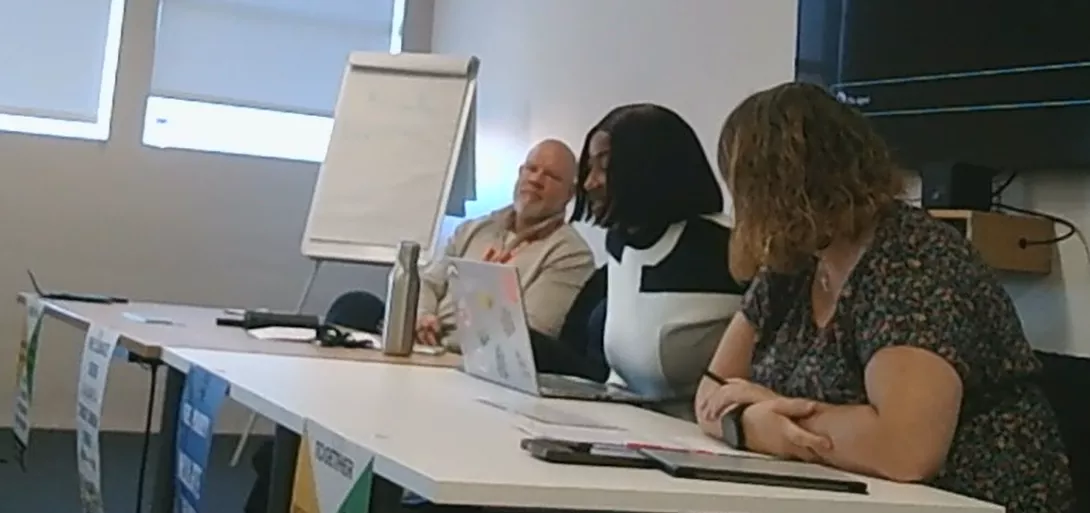
This guest post is the text of a speech by Princess Akinwale, Branch Secretary, UNISON Greater London Care, at our conference, "No Non-Radical Futures Available: Winning for the Climate, Winning for Workers"
Good afternoon, comrades, colleagues and friends.
I am pleased to be here today, not only as a trade unionist, but as a care worker, a migrant worker, a Black woman and someone who has seen first-hand what happens when the people who sustain our society are treated as though they are disposable.
We have gathered here under a powerful theme: No Non-Radical Futures Available.
And I believe that title captures something we must all confront.
We cannot continue to respond to extraordinary crises with ordinary thinking.
We cannot address a climate emergency while preserving the inequalities that make communities vulnerable in the first place.
And we cannot speak about a just transition without asking a fundamental question:
Just for whom?
1. The National Emergency Briefing: A warning we cannot ignore
In November 2025, ten leading experts gathered at Westminster to deliver the National Emergency Briefing on the climate and nature crisis.
They examined the consequences of climate breakdown for our health, food security, economy, national security and environment.
Their message was unmistakable: climate change is not simply a distant environmental concern. It is a threat to the systems upon which our lives depend.
And the evidence is deeply concerning.
The warnings included increasingly dangerous heatwaves, floods, disruptions to food production and mounting risks to public health.
A parliamentary motion responding to the briefing highlighted projections that up to one in four UK properties could be at risk of flooding by 2050.
Think about what that means.
Behind those properties are families. Behind those families are workers. Behind those statistics are elderly people, disabled people, children and communities whose lives could be profoundly disrupted.
But the National Emergency Briefing also offered something important: the recognition that urgent action can create a healthier, more resilient and fairer society.
So, for me, the question is no longer simply whether we understand the climate emergency.
The question is whether we are prepared to change the systems that make its consequences so unequal.
2. The forgotten workforce in the climate conversation
Comrades, when we talk about climate jobs, we rightly discuss renewable energy, sustainable transport, housing insulation and cleaner industries.
These are essential.
We need engineers, electricians, construction workers, scientists and technicians.
But I want to speak today about another workforce.
A workforce that is overwhelmingly female, often poorly paid, frequently undervalued and too easily forgotten.
Care workers.
Let me ask you something.
When temperatures rise to dangerous levels, who will support an elderly person who cannot regulate their body temperature?
When severe flooding disrupts transport, who will make sure a disabled person still receives essential support?
When climate-related illness places additional pressure on our health system, who will care for people returning home from hospital?
And when communities experience emergencies, who will continue supporting those who cannot simply evacuate, relocate or look after themselves?
Very often, the answer will be care workers.
Yet we rarely appear at the centre of conversations about the workforce needed for a climate-resilient future.
This must change.
Care work is not necessarily a green job in the same sense as installing solar panels or building wind turbines.
But it is an essential part of the social infrastructure that makes climate resilience possible.
And a truly just transformation must invest in both environmental and social infrastructure.
Because what is the point of building a sustainable city if the people living in it cannot access the care they need to survive?
3. You cannot build a fairer future on insecure employment
I speak as Branch Secretary of UNISON Greater London Care, representing a branch of more than 3,000 members.
Many of the workers whose concerns we raise are women. Many are migrants. Many are among the lowest-paid workers in our society.
These are people who provide essential services, yet too often experience insecurity in their own working lives.
Some struggle to secure their contractual hours.
Some face unpredictable working patterns.
Some are expected to provide physically and emotionally demanding care without adequate staffing or support.
And some migrant care workers face an additional vulnerability: their right to remain and work in this country may be closely tied to their sponsoring employer.
Imagine being an essential worker in a country where your labour is needed, but your employment security and immigration status can leave you afraid to challenge unfair treatment.
Now imagine that same worker being expected to help sustain essential services during a climate emergency.
This contradiction should trouble every one of us.
Because the workers we depend upon in times of crisis must not be the workers we abandon in ordinary times.
A just transition cannot be built on exploitation.
It cannot be built on poverty wages.
And it cannot be built on the silence of workers who are afraid of losing their livelihoods.
If we want a resilient society, we must first build a secure and respected workforce.
4. Climate justice is also international justice
I also want to bring an international perspective to this conversation.
I come from Nigeria, a country where many communities face the consequences of environmental degradation, flooding, extreme heat and threats to livelihoods.
Across Africa, climate vulnerability intersects with poverty, inadequate infrastructure and deep global economic inequalities.
And there is an uncomfortable reality we must acknowledge.
Many countries that have contributed comparatively little to historical greenhouse gas emissions are among those facing some of the most severe consequences.
Meanwhile, wealthier industrialised nations have benefited enormously from generations of fossil-fuel-intensive economic development.
That is why climate justice cannot stop at national borders.
It is not enough to demand cleaner energy here while ignoring the conditions under which minerals are extracted, goods are manufactured or workers are employed elsewhere.
It is not enough to celebrate green investment if its supply chains depend on exploitation in poorer countries.
And it is not enough to talk about global solidarity while treating migrant workers as though their rights are somehow less important.
As a migrant worker and trade unionist, I see these issues as connected.
The climate crisis crosses borders.
Our economies cross borders.
Our labour markets cross borders.
And our solidarity must cross borders too.
We must reject any approach that pits British workers against migrant workers, or workers in wealthy countries against workers in the Global South.
The solution to inequality is not division.
The solution is collective action, fair investment and rights that protect every worker.
5. The jobs we need must be decent jobs
So what should the jobs of the future look like?
First, they must be jobs that protect our environment.
We need workers building renewable energy systems, improving housing, restoring nature and developing sustainable public transport.
But we must also recognise the workers who protect our communities.
We need properly funded social care, strong public health services, emergency preparedness and resilient local government services.
We need care workers trained and equipped to respond safely to extreme heat, flooding and other environmental risks.
We need care homes and community services that can continue operating when extreme weather disrupts power, transport or essential supplies.
And we need workers to have a genuine voice in how these services are designed.
But creating more jobs is not enough.
The quality of those jobs matters.
A climate job that pays poverty wages is not a just-transition success.
A job that exposes workers to unsafe conditions is not decent work.
A job that denies trade union representation is not the foundation of a fairer society.
And a job that depends on the exploitation of migrant labour cannot be celebrated as social progress.
We must insist that the jobs we create are secure, fairly paid, safe, unionised and accessible to the communities that need them.
Because a greener economy is not automatically a fairer economy.
Fairness must be deliberately built into it.
6. The role of trade unions: From awareness to collective power
Comrades, we have heard the scientific warnings.
We have seen the extreme weather.
We understand the economic and social risks.
But awareness alone does not change the world.
Organisation does.
That is where trade unions have a responsibility that goes far beyond responding to individual workplace disputes.
We must become central voices in shaping the transition.
Not simply reacting to government policy after decisions have been made, but helping determine what a just transformation should look like.
We should be asking employers and public authorities difficult questions.
How will essential services continue during extreme weather?
Are workers being trained to respond to climate-related risks?
Are low-paid workers included in transition planning?
Will new investment create secure, unionised jobs?
And who is being left out of the conversation?
These questions belong in our workplaces, our branches, our bargaining agendas and our national campaigns.
We also need to challenge the false choice between protecting jobs and protecting the planet.
Workers should never be forced to choose between earning a living and having a liveable future.
That is not a choice we should accept.
Our demand must be for both.
Climate action with workers' rights. Environmental protection with economic security. And a just transition with nobody left behind.
7. Three demands for our movement
I want to leave this conference with three practical demands.
First: Recognise social care as essential climate-resilience infrastructure.
Climate planning must include the people and services that protect vulnerable communities. That means properly funded care services, emergency preparedness, safe staffing and investment in the workforce.
Second: Make decent work a non-negotiable condition of the just transition.
Public investment should support fair pay, secure contracts, safe working conditions, training, collective bargaining and equal protection for migrant workers.
We must not allow a new economy to reproduce the exploitation of the old one.
Third: Put low-paid workers, women and migrant workers at the centre of climate decision-making.
Do not simply invite us to listen after policies have been written.
Include us when priorities are being set.
Include us when resources are being allocated.
Include us when the future of work is being negotiated.
Because those who experience inequality most directly often understand most clearly where systems are failing.
And their voices are indispensable to building something better.
8. Conclusion: The future we are fighting for
Comrades,
The National Emergency Briefing challenged our understanding of the danger we face.
But this conference challenges us to consider what we are prepared to do about it.
And I believe the answer must be bigger than reducing emissions alone.
We must build a society where our environment is protected, where essential services are resilient, where communities are safe and where workers are treated with dignity.
A society where a care worker does not have to choose between paying her bills and speaking up about unsafe working conditions.
A society where migrant workers are valued not only for their labour, but respected as human beings.
A society where the poorest communities are not expected to pay the highest price for a crisis they did the least to create.
And a society where protecting the planet and protecting working people are understood as part of the same struggle.
Because there is no climate justice without social justice.
There is no just transition without decent work.
And there can be no sustainable future if the people who sustain our society are left behind.
So when we leave this conference, let us leave with more than concern.
Let us leave with organisation.
Let us leave with solidarity.
And, above all, let us leave with the determination to turn scientific warnings into collective action.
The future will not become fairer simply because it becomes greener.
We must organise to make it fairer.
Thank you.
Solidarity.